As dusk settles and the first stars begin to pierce the deepening blue, there's a quiet magic that descends upon a summer night. The air, still warm from the day's sun, carries the scent of earth and blooming night flowers. It is in these hours, away from the glare of city lights, that the cosmos truly unveils itself. The vast expanse above is not merely a random scattering of distant suns; it is an ancient map, a storybook written in light, waiting for those who are willing to look up and read its tales. This is the perfect time for a personal quest: to find your own celestial lighthouse among the constellations.
For millennia, humans have gazed upon the same star patterns, finding in them gods, heroes, beasts, and objects from their myths and daily lives. These constellations were more than just pictures; they were guides. Sailors used them to navigate treacherous seas, farmers relied on them to mark the changing seasons, and storytellers used them to pass down legends through generations. In our modern world, with GPS in our pockets and artificial light polluting our skies, we have largely lost this intimate connection to the heavens. Yet, the desire to find meaning and guidance in the stars remains a deeply human impulse. Your personal constellation isn't necessarily one assigned by ancient astrology; it is the pattern that speaks to you, that captures your imagination and perhaps, in some small way, helps you find your bearings.
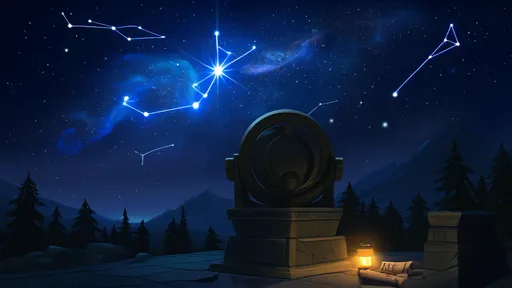
Before you can find your lighthouse, you must first learn to see the sky. This begins with finding a true dark sky. It may require a drive away from the urban glow, to a countryside field, a quiet beach, or a remote hillside. Allow your eyes at least twenty minutes to adjust to the profound darkness; this is when the fainter stars and the hazy band of the Milky Way will begin to emerge into view. Start with the most prominent summer constellations. In the northern hemisphere, the Summer Triangle—comprising the bright stars Vega, Deneb, and Altair—dominates the overhead sky. This asterism is your gateway. From there, you can trace the delicate harp of Lyra, the sweeping wings of Cygnus the Swan flying along the Milky Way, and the noble shape of Aquila the Eagle.
Further south, the red supergiant Antares marks the heart of Scorpius, one of the few constellations that truly resembles its namesake. Following the arc of its tail leads you to the teapot-shaped asterism of Sagittarius, which points toward the very center of our galaxy. These are the landmarks. But a lighthouse is more specific. It is not the entire coastline, but the single, steady beam that cuts through the darkness to show you the way. Your constellation lighthouse might be one of these larger patterns, or it could be a smaller, less conspicuous grouping that holds a special significance for you.
How do you find it? The process is not one of frantic searching, but of patient observation and reflection. Lie back on a blanket. Let your gaze wander. Don't try to force it. Instead, pay attention to which patterns your eyes are naturally drawn to again and again. Is it the distinct quadrilateral of Delphinus the Dolphin, leaping joyously through the sky? Or perhaps the delicate circlet of Corona Borealis, the Northern Crown, a perfect little half-circle of stars? Maybe it's the challenging but rewarding shape of Hercules, a testament to patience and effort. Think about what these shapes evoke in you. Does a particular constellation's myth resonate with a chapter of your own life? Does its steadfast presence year after year offer a sense of comfort and permanence?
For some, the lighthouse might be Polaris, the North Star. While not a constellation itself, it is the unwavering point around which the entire northern sky pivots. It is the ultimate symbol of guidance and constancy. Finding it is simple: follow the two pointer stars of the Big Dipper's bowl directly to it. There it shines, a reliable beacon that has guided travelers for thousands of years. In your life, your lighthouse should serve a similar purpose. It is not about navigation in a literal sense, but about providing a fixed point of wonder, a reminder of your place in a vast universe, and a source of inspiration when you feel lost in the complexities of daily life.
Once you believe you have found it, learn its story. Read the ancient Greek myth behind it, or the interpretations from other cultures around the world. Learn when it is highest in the sky and when it dips below the horizon. This knowledge deepens the connection, transforming a pretty pattern of lights into an old friend you can visit each summer. Your constellation becomes a part of your personal story, a celestial touchstone. On future summer nights, no matter where you are or what is happening in your life, you can step outside, find your lighthouse shining steadily in the dark, and feel a sense of cosmic perspective and peace.
The summer sky is a temporary masterpiece, changing with the seasons. But the constellations are eternal on a human timescale. They are a heritage that belongs to everyone. In finding your own constellation lighthouse, you are not claiming a piece of the sky, but rather claiming your right to wonder, to find beauty and personal meaning in the universe. So this summer, take the time. Venture out into the warm night, lie back, and look up. Let the stars tell you their stories, and listen for the one that calls out to you. Your lighthouse is waiting.
By /Sep 5, 2025

By /Sep 5, 2025

By /Sep 5, 2025

By /Sep 5, 2025

By /Sep 5, 2025

By /Sep 5, 2025
By /Sep 5, 2025

By /Sep 5, 2025

By /Sep 5, 2025
By /Sep 5, 2025

By /Sep 5, 2025

By /Sep 5, 2025
By /Sep 5, 2025
By /Sep 5, 2025

By /Sep 5, 2025

By /Sep 5, 2025

By /Sep 5, 2025
By /Sep 5, 2025
By /Sep 5, 2025

By /Sep 5, 2025
